D&D Party Portrait Commission: The Complete 2026 Guide
D&D Party Portrait Commission: The Complete 2026 Guide
After 200+ commissions and two years of group work, here is exactly how a D&D party portrait should be scoped, briefed, priced, and timed — written by the artist who paints them.
After two years and 200+ commissions, the single request that lights up a D&D table more than any other is a party portrait. A single character portrait is for one player. A party portrait is for a campaign. It is the artifact that survives the campaign — the thing that gets framed, printed on a giant metal print for the DM's wall, and sent around the group chat ten years later when someone asks "remember Strahd's vineyard?"
We have shipped party portraits for groups of 3, 4, 5, 6, and once a chaotic eight. They are the highest-value commission a table can buy, and they are also the easiest to screw up if the group has not aligned on what they actually want before sending us a brief. This guide is the conversation we end up having with every party that books one — pricing, formats, turnaround, briefing, gifting, and the small decisions that turn a good party portrait into the one your group will fight over who gets the first print of. Every piece described here is a digital painting, hand-painted in Procreate, Photoshop, or Clip Studio Paint by Hector G. on a tablet with a stylus. No AI, no generators. A real human painting your party, layer by layer.
The three formats for a party portrait
Before you talk price, you have to decide which format you actually want. We offer three, and the difference is not cosmetic — each one is a different commission, a different file structure, and a different price bracket.
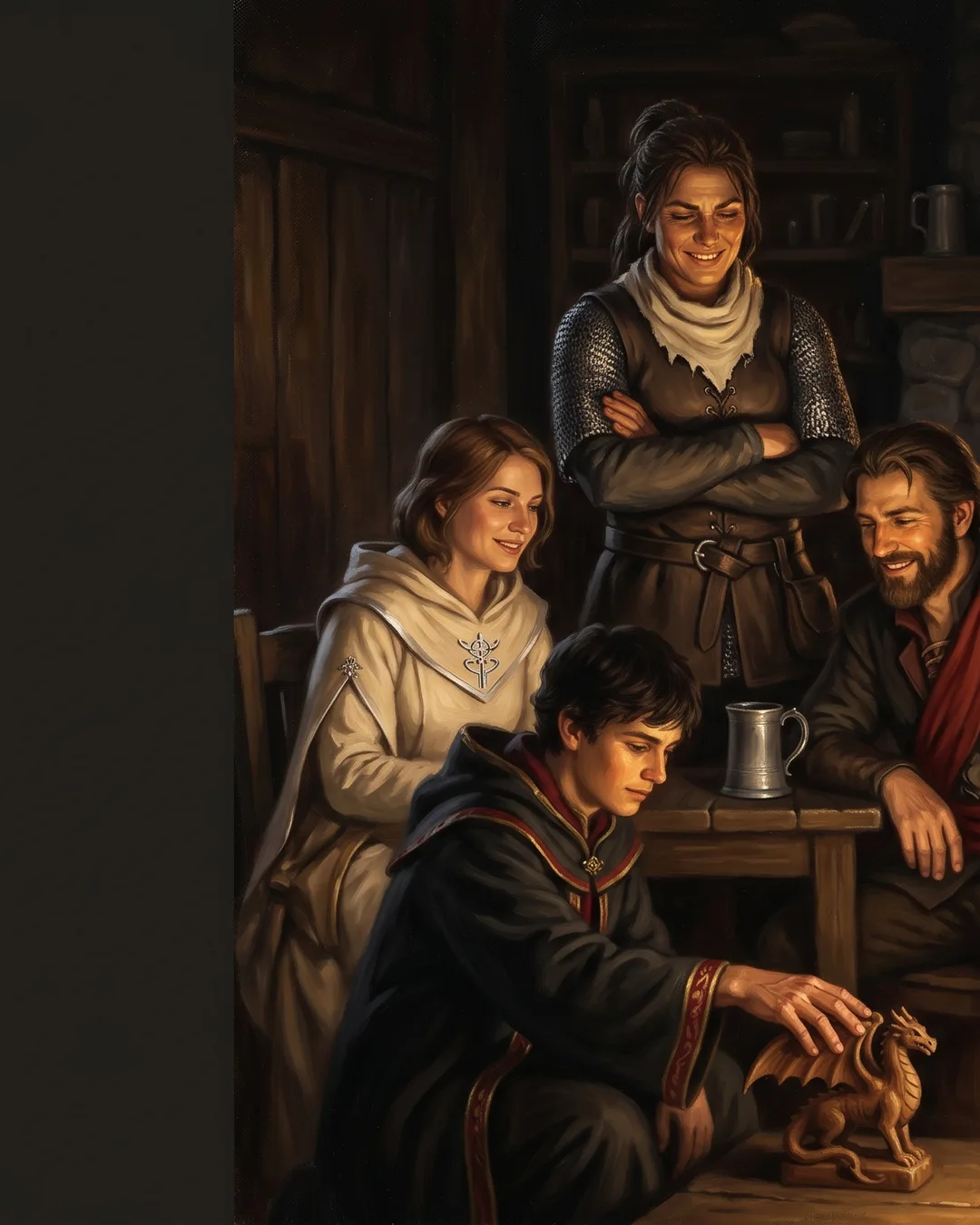
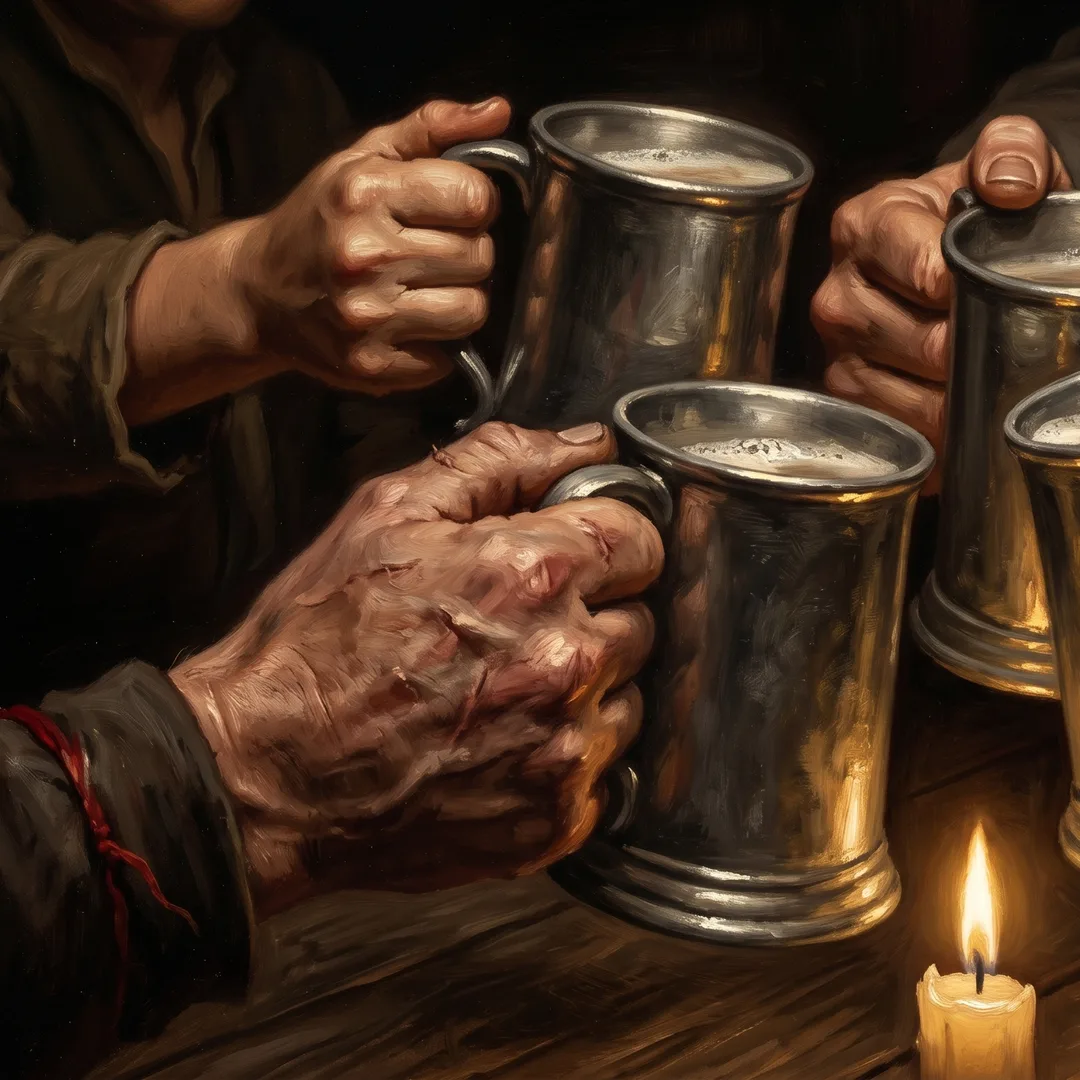
Format 1: all-in-one scene. Every character lives inside a single digital painting. The classic version is the party around a tavern table, mugs raised. We also do campfire scenes, war-room maps, throne-room standoffs, and "we just survived something" group shots. Single layered file, one final delivery, one print. This is the format that becomes the wall piece. Roughly 60% of our party commissions go this way.
Format 2: matched-style individual portraits. Each player gets their own painted file, but every portrait is painted to the same register — same lighting key, same palette family, same level of finish, same background treatment. Hung as a 4-up or 6-up grid, the set reads as one work. Best for groups where players want their own framed print but also want the set to feel unified. Roughly 25% of our group work goes this way.
Format 3: action scene. A single moment from a real session — the round you finally dropped the BBEG, the moment the rogue jumped onto the back of the dragon, the time the bard somehow rolled three nat 20s in a row. Hardest of the three to paint, highest cost, longest turnaround, and the one you will remember forever. Roughly 15% of our commissions go this way, and every one of them has been worth it. See examples of all three on our portfolio.
The format you pick changes everything downstream — price, timeline, briefing, the way the file is delivered. Pick the format before you pick the players who get a print. If you want help deciding, our party work service page has side-by-side examples of all three.
How party-portrait pricing actually works
Party portrait pricing is not a flat rate. It is per-character base, plus complexity, plus background. Here are the real numbers we quote in 2026, the same numbers you will see on our pricing page.
Bust tier (head and shoulders, painted background wash): $60 per character. A 4-character bust party comes out to $240 total. A 6-character bust party is $360. This is the entry point and the most popular tier for groups that want everyone on a wall but are splitting the cost five ways.
Half-body tier (waist up, painted background, full gear visible): $120 per character. A 4-character half-body party lands at $480. A 6-character group at this tier is $720. This is the sweet spot for matched-style sets — gear reads, faces read, and prints look great at 12x16 inches.
Full-body in a single scene tier: $600 to $900 depending on character count and scene complexity. A 4-character tavern scene with painted environment runs $650. A 5-character campfire with a forest backdrop runs $780. A 6-character throne room with architectural detail runs closer to $900. Single composition, single file, single print.
Action scene tier: $900 and up. A 4-character action moment with motion, effects, and full environment starts at $950. A 5-character action scene with magic effects and lighting drama runs $1,200. These are the most labor-intensive pieces we do.
Bundle discounts. Any party of 4+ characters at the same tier gets 10% off. Parties of 6+ get 15% off. A pet, familiar, or animal companion is +$30 for bust tier, +$50 for half/full body. All quotes include two rounds of revisions on the sketch stage and one round on the color stage. Splits across players are easy — we invoice the coordinator and you sort the split internally.
Turnaround: what to expect for a group
Group work takes longer than single-character work — not linearly, but predictably. Here are the timelines we actually hit in our queue.
4-character bust party: 14 to 21 days. Fastest format we offer for a group. Sketches go out in week one. Color blocks in week two. Final files in week three. Most bust parties land at day 16.
Matched half-body party (4-6 characters): 4 to 6 weeks. Each character is its own file, which means each one gets the full sketch-color-finish pass. We batch the sketch stage so you see all characters together at the same register, then move into color, then finish. A 4-character set typically lands at week 4. A 6-character set typically lands at week 6.
Full-body single scene (4-6 characters): 4 to 5 weeks. The composition phase is the longest part — getting six bodies to actually fit together in one frame without looking like a yearbook photo takes real iteration. Sketches in week one and two. Color blocks in week three. Finish in week four and five.
Action scene: 5 to 7 weeks. These pieces have the most moving parts. Pose iteration, effects iteration, lighting iteration. We never rush an action scene.
Delivery is staged and digital. You get a shared link as soon as the sketch is ready, another when the color block is done, and the final layered file plus flattened high-resolution exports when the painting is finished. No surprises at the end. You see the work as it builds. To get an active slot, submit on our order page.
Briefing a party portrait (this is where most groups go wrong)
In our 200+ commissions, the single biggest predictor of a great party portrait is not budget — it is the brief. And group briefs go wrong in a specific, repeatable way: one person writes the brief for everyone, and the result is a painting where one character looks like the player imagined them and four characters look like a stranger's idea of who they are.
The fix is two-pass briefing, and it is non-negotiable on group commissions over $300.
Pass 1: individual character briefs. Every player submits their own character brief. Race, class, level, hair, eyes, skin, scars, signature gear, signature pose, three reference images, and — most importantly — three sentences describing the character's personality the way the player describes them at the table. Not the way the character sheet describes them. We give every player our standard first-timer guide and ask them to follow it.
Pass 2: the group brief. One person — usually the DM, sometimes a coordinator — submits the group brief. This covers: setting (tavern, campfire, throne room, ruined chapel, ship deck), composition cue (who is at the center, who is at the edges, who is touching, who is apart), the moment captured (a quiet beat, a toast, mid-combat, a standoff), group palette reference (warm and golden, cold and blue, lantern-lit, daylight, magical glow), and the title or session that inspired the piece.
Two-pass briefing takes the group about 45 minutes of coordinated effort. It saves us — and you — roughly two weeks of revisions on the back end. Groups that skip pass 2 always end up doing it later, except by then the sketch is wrong and we are repainting it. Do the brief once, do it right. See exactly what to include on the party work service page.
Campaign-end vs mid-campaign — which is better?
This is the second question every group asks us, after price. The honest answer is: both are good, for different reasons.
Mid-campaign portraits capture characters at their current power level — current gear, current scars, current relationships. The artist gets to paint the character the player has actually been playing for the last six months, not a memory of who they were at level 1. Coordination is easier because the group is still actively meeting. Players are still excited about their characters. Reference is fresh. About 40% of our party commissions are mid-campaign, usually painted at the halfway point of a long campaign or after a major arc.
Campaign-end portraits capture the party as the group will remember it forever. Final gear, final scars, the version of the character that survived (or, painfully, did not). The emotional payoff is bigger. The piece becomes the keepsake — the thing that gets framed, printed for every player, and referenced in every "remember when" conversation for years. About 60% of our party commissions are campaign-end or post-campaign, often commissioned within a month of the final session.
Our recommendation: if your campaign is long-running with no end date, do mid-campaign now and a second piece at the end. If your campaign has an end in sight, wait. The post-campaign portrait, painted while the memory is still fresh, is the one that will hang on the DM's wall for the next decade. If you cannot decide, look at three or four examples from our portfolio — you will know within five minutes which timing fits your table.
Party portraits as gifts (the DM-surprise angle)
The single most rewarding category of party portrait we paint is the DM gift. About one in four of our group commissions is a surprise for the dungeon master, organized by the players, paid for in a split, and revealed at the final session. We have a specific workflow for this, refined over dozens of these commissions.
The "one player collects briefs in secret" workflow. One player — usually the most organized one, sometimes the only one who can keep a secret — becomes the coordinator. They collect individual briefs from every other player in private DMs. They write the group brief themselves, usually capturing a memorable moment from the campaign that the DM ran. They handle the payment split. They handle the delivery. The DM finds out at the reveal.
Coordinator tips from our queue. Set a hard deadline for player briefs that is at least one week before you submit to us. Players will be late. Plan for it. Pick a moment from the campaign that the DM was proud of — a setpiece they built, a villain they wrote, a location they described in loving detail. The DM will recognize their own work in the painting, and that recognition is the emotional payoff. Don't try to surprise the DM with a character the DM has not seen — paint the party as the DM knows it.
Budget for a DM gift. Most DM-surprise commissions we paint are at the matched half-body or full-body single-scene tier, splitting four to six ways. A $480 half-body 4-party splits to $120 per player. A $780 full-body 5-party splits to $156 per player. Affordable for the table, unforgettable for the DM. Start the brief on our order page once your coordinator has the briefs collected.
FAQ
How many characters maximum? We have painted parties of eight. We do not recommend more than six. Above six, faces start to compete for space, and the painting becomes a crowd scene rather than a party portrait. Four to six is the sweet spot. If you have a party of eight, we will tell you honestly which two characters will read smallest and let you make the call.
Different species in the same painting? Yes, every time. A halfling next to a goliath next to a tiefling next to a human is the normal D&D party. We paint scale relationships carefully — the halfling does not get cropped out and the goliath does not eat the frame. Scale and grouping are a normal part of the composition pass.
Non-humanoid party members? Yes. We have painted warforged, dragonborn, kenku, tabaxi, tortles, centaurs, plasmoids, and one very memorable awakened mimic disguised as a treasure chest. If your character has feathers, scales, fur, gears, ooze, or roots, we will paint them. Send reference, send detail notes, send the player's three sentences on personality, and we will figure out the rest.
What if a player drops out before the commission is done? Two options. We paint them out — easier at sketch stage, possible up through color block, harder at finish. Or we replace them with an NPC the party has bonded with. This happens about twice a year in our queue. We will not charge for the dropped character if we catch it before the color stage.
Pet, familiar, or animal companion? Yes, and we love painting them. +$30 for bust tier, +$50 for half-body or full-body. Owls, ravens, foxes, wolves, pseudodragons, cats, ferrets, mechanical companions, and one very good axe beak named Steven have all made it into our party portraits.
Print rights? You own the painted image for personal use, including unlimited personal prints. We retain rights to display the work in our portfolio unless you request a private commission, which is available for an additional 20%.
Ready to commission your party portrait?
If your table is ready, the next step is the brief. Send your group to our party work service page for the full briefing template, then start a commission on our order page. We will reply within 48 hours with a quote, a timeline, and a slot in the queue. Painted by a human in Procreate, Photoshop, or Clip Studio Paint — not generated, not auto-filled, not stitched together from someone else's work. Your party, painted properly, by an artist who reads your brief.